







What is a Residual Useful Life Assessment?
A residual useful life assessment estimates how long a building can still be used economically from today’s perspective. It is not a market value or purchase price assessment, but exclusively a forecast of the remaining period of use from an economic standpoint.
The central question is: “How long can the building likely be used in its current condition?”. Such an assessment is carried out by qualified experts who inspect the building and include various factors. These include, among others: Structural condition (e.g., load-bearing structure, roof, facade). Technical equipment (age/condition of heating, pipes, electrics). Scope of previous renovations (which modernizations were carried out?).
Energy efficiency of the building (thermal insulation, windows, heating system). The goal of the assessment is a plausible, comprehensible forecast of the residual useful life — not an exact prediction in years.
The report must be well-founded and is only an option if there are objective reasons for a shorter period of use. Important: a residual useful life assessment does not automatically replace the depreciation rates prescribed by law. Rather, it must be soundly justified in each individual case to be recognized by the tax office.
How Does Depreciation (AfA) Work in Principle?
For residential buildings, the legislator generally assumes a useful life of 50 years, which corresponds to linear depreciation of 2% per year. This means that 2% of the building’s acquisition costs can be claimed as depreciation for tax purposes each year. In practice, 50 years is the common value (e.g., for residential buildings built after 1925).
For older properties or special building types, different flat rates sometimes apply (e.g., commercial real estate often with a shorter duration due to higher wear and tear). However, the Income Tax Act expressly allows deviations from this 50-year rule if the actual useful life is shorter and this is demonstrated in a comprehensible manner (§ 7 Para. 4 Sentence 2 EStG).
Specifically: if the owner submits a convincing assessment proving a shorter residual useful life, the tax office must adjust the AfA and distribute the depreciation over the shorter period. The annual depreciation amount increases because the same building value is distributed over fewer years. Total depreciation over the lifespan remains the same, but the annual AfA amount increases, which reduces taxable income each year. Thus, with a single assessment, it is possible to save taxes every year for years.
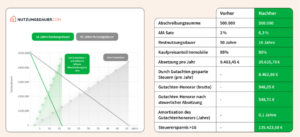
Example (as shown in the graphic): Suppose the depreciation base (building share) is €500,000; the property purchase price share after allocation is 85%. Without an assessment, the property is depreciated as a flat rate over 50 years — which corresponds to an AfA rate of 2% and a deduction per year of €9,483.45. If, on the other hand, a residual useful life of 16 years is comprehensibly proven by an assessment, this results in an AfA rate of 6.3% and thus an annual deduction of €29,635.78. That is €20,152.33 more depreciation per year — in this calculation example, that corresponds to tax savings of €8,463.98 per year and a total of €135,423.68 over 16 years. Opposite this is an appraisal fee of €946.05 gross (or €548.71 after tax deduction), which in this example pays for itself in just 0.1 years. Anyone who wants to simulate such scenarios quickly can use the AfA calculator from Nutzungsdauer.
Courts have now confirmed that the required proof of a shorter period of use can also be provided by structured evaluation models, provided they are applied appropriately and well-founded. For example, the Federal Fiscal Court clarified in a recent ruling that economic residual useful lives must generally be recognized if they are rigorously derived. Nevertheless, the tax administration examines each case very closely on an individual basis. Reduced depreciation according to an assessment is therefore possible and legal, but it requires a well-founded justification.
Why is Only the Building Value Depreciated?
A central point in building depreciation: only the building itself is depreciable – not the land. Land is considered non-wearing for tax purposes and is therefore not depreciated. When buying a property, the purchase price must always be split into a land component (not depreciable) and a building component (depreciable). Only the building value enters into the AfA calculation — and thus also into a residual useful life assessment. This separation is mandatory and clearly required by case law.
In practice, this means: if you pay e.g. €500,000 for a built-up plot, the full €500,000 cannot be depreciated via AfA. First, it is determined which part corresponds to the soil (land) — this part remains unchanged and cannot be depreciated. Only the remaining building value — often e.g. 70% to 80% of the purchase price, depending on location — may be depreciated over the years. For a residual useful life assessment, consequently, only the building share is relevant.
How is the Purchase Price Allocated?
To determine the building share of the purchase price, there are various approaches:
Standard method of the tax administration: Often the calculation aid of the Federal Ministry of Finance is used. In this case, the land value is calculated based on the official standard land value (Bodenrichtwert) times the property area. The difference to the total purchase price gives the building share. This procedure is standardized, but can lead in individual cases to a very high land value being applied (especially in expensive locations), which reduces the building share and thus the AfA.
Allocation according to purchase contract: An allocation key for land and buildings held in the purchase contract can provide an indication, but is not binding for the tax office. The authority can deviate from it if the allocation seems unrealistic.
Expert assessment: An independent assessment for purchase price allocation is considered particularly robust — especially if there are significant deviations from the usual standard land value shares. Courts regularly recognize conclusive assessments for allocation, provided they realistically reflect local conditions. Especially in regions with sharply risen standard land values (e.g. Berlin), an assessment can often justify why the actual land value share is lower than assumed as a flat rate. A lower land value leads directly to a higher building share — and thus to more depreciation potential.
Conclusion: For depreciation and a residual useful life assessment, the correct purchase price allocation is essential. In case of doubt, it is worth having this checked by an expert, especially if the standardized method results in an unusually low building share.
Which Factors Influence the Residual Useful Life?
Decisive for the residual useful life is not age alone of a building, but above all its current condition. Old buildings can still be usable for a long time with good care and renovation, while relatively young buildings with structural defects may reach the end of their use earlier. Important influencing factors are in particular:
Building substance: condition of roof, facade, load-bearing walls, etc. Defects in the substance (e.g. a dilapidated roof) can significantly reduce the residual useful life.
Technical infrastructure: age and condition of the house technology (heating, electrics, plumbing). Obsolete or worn-out systems shorten the period of use; new systems extend it.
Previous modernizations: scope and quality of renovations/modernizations in the past. If important elements (roof, pipes, windows, etc.) were renewed, this increases the remaining period of use.
Energy standard: is the building energy-efficient according to today’s standard (insulation, heating technology)? If not, this can limit its economic usability in the future, for example due to required retrofitting.
Missing or only partially carried out modernizations shorten the economic useful life, while comprehensive renovations can extend it. Evaluation models according to ImmoWertV help to capture these factors systematically, but do not replace an individual assessment. Ultimately, each case must be considered individually — two houses of the same age can have very different residual useful lives if one, for example, is core-renovated and the other is not.
For Which Properties is a Residual Useful Life Assessment Worthwhile?
A residual useful life assessment is particularly sensible when there are signs of a significantly shorter useful life than 50 years. Typical cases from practice (especially in old building stock) are for example:
Very old buildings without core renovation: e.g. old buildings built before 1925, where a comprehensive modernization never took place. Here, the standard 50- or 40-year AfA is often set too long.
Properties with significant maintenance backlog: such as houses or apartments with obsolete house technology (heating, electrics, plumbing) and visible renovation needs. Such objects may no longer economically have full 50 years of usage time if no investment is made.
Condominium associations (WEGs) with necessary major repairs: if expensive renovations (roof, facade, pipes, etc.) are foreseeably pending in the common property of a multi-family house that have not yet occurred, this can influence the period of use of the individual apartments.
Poorly insulated buildings before energy renovation: if energy measures are pending in the near future but have not yet been implemented, one can argue that in the current state, economic usability is limited (e.g. due to future higher operating costs or legal requirements).
In all these cases, an individual case review is worthwhile. Generally for all properties, one can say: the older a building and the less modernized, the greater the chance that an assessment can show a shorter residual useful life. As a rough rule of thumb, objects older than approx. 30 years without core renovation have the best chances for a shortened period of use. For commercial properties, an assessment can sometimes be worthwhile for buildings as young as 10–20 years, as wear and tear occurs faster here.
Tip: Whether a residual useful life assessment is worthwhile for your own property can be checked risk-free in advance. For example, the specialized provider Nutzungsdauer.com offers a free initial assessment, in which an estimate is made based on some property data as to whether an assessment is likely to result in a reduction of the period of use. Thus, owners take no cost risk, but first receive a rough forecast (including expected residual useful life range). Only if this turns out positive can an assessment be commissioned — combined with a money-back guarantee if the tax office does not recognize the new AfA. More on these advantages below.
Owners Residing Abroad
Even landlords living abroad can profit from residual useful life assessments. The decisive factor is that the property is in Germany — because rental income from German properties is subject to German taxation (even if the owner lives abroad). In the German tax return, an owner based abroad can also apply a shorter residual useful life, provided a recognized assessment is available. How this affects the owner’s country of residence depends on the respective double taxation agreement — often German rental income is exempted there or only partially credited. In any case, a tax return must be filed in Germany to claim the increased depreciation. Here too: coordination with an international tax consultant is advisable, but the assessment itself can be used exactly as for domestic owners.
What do Tax Offices Particularly Pay Attention to?
The tax offices examine submitted residual useful life assessments very closely. Deviations from the normal AfA rates are always individual case decisions and must be well-founded. Frequent reasons why an assessment is not recognized are for example:
Insufficient qualification of the expert: The assessment does not come from a relevant specialist (e.g. no building expert or certified appraiser). Absence of thorough property inspection: If the expert does not personally inspect the property or only checks it superficially, it lacks substance. An assessment from the desk without an on-site appointment rarely convinces the tax office.
Pure schematic calculation without property reference: If the residual useful life is derived purely schematically by means of general formulas or table values, without including the peculiarities of the concrete building, the tax office will oppose it.
Ignoring individual peculiarities: Each building has special properties. If these are not discussed in the assessment (e.g. historical building substance, monument protection, special materials), the necessary individuality is missing.
In summary: the assessment must be founded, property-related, and created by a competent authority. Then the chances of recognition are very good. Flat AfA rates remain the rule, but reasoned exceptions are permissible — current case law explicitly confirms this procedure. Nevertheless, the procedure is not simplified: owners should therefore value quality. In case of doubt, it is recommended to commission a market leader in this field who uses experienced and certified experts. Providers like Nutzungsdauer.com for example accompany the owner through the entire process — from document acquisition to communication with the tax office to successful recognition — and achieve a recognition rate of over 99% thanks to high quality.
FAQ – Short Answered
What does a residual useful life assessment cost?
The costs are not regulated uniformly, but depend on the concrete object (size, effort). For a typical condominium, they are in the lower four-figure range. Some providers publish price scales — e.g. an assessment at Nutzungsdauer.com for living spaces up to 299 m² costs around €946 (incl. VAT). Important: In case of rental, the assessment costs can be tax-deductible as income-related expenses, so the actual burden is reduced even further.
Is an evaluation model sufficient?
Yes, a structured evaluation model can be sufficient if it is applied correctly and justified comprehensibly. In other words: the assessment must not just spit out a formula, but must explain why this formula fits in the special case. In practice, recognized models (such as according to ImmoWertV) are used, but always combined with an individual assessment of the object.
How up-to-date must the standard land values (Bodenrichtwerte) be?
As up-to-date as possible. Since the allocation into land and building value is essential for AfA, one should fall back on the latest available standard land values. In many regions — so also in Berlin — these values are re-established annually as of January 1st. An assessment should take the currently valid reference values into account so that it is accepted by the tax administration.
Does this also apply to condominiums?
Yes. For apartments, the shortened period of use is applied proportionately to the building value of the apartment. This means that both the land and the building share of the purchase price are first determined as for a total building. The AfA-relevant part (building share) is then possibly depreciated over fewer years by the assessment. For the condominium, this works analogously — one also profits from higher annual depreciation.
Does energy efficiency play a role?
Yes, the energetic state of a building is a factor for the residual useful life. Houses with very poor energy efficiency could become uneconomic in the future (keywords: heating costs, renovation obligation), which shortens the useful life. Conversely, energy modernizations (insulation, modern heating) increase the lifespan from an economic point of view. In the assessment, the energetic standard is therefore included and can be an argument for a shorter (or longer) useful life.
Who is allowed to create a residual useful life assessment?
Legally there is no specific “license system”. In practice, however, publicly appointed or certified experts should issue such an assessment so that it has weight. Ideally, the expert has a certification according to DIN EN ISO/IEC 17024 (standard for personal certification) in the field of real estate evaluation. Providers like Nutzungsdauer.com for example work exclusively with such certified experts. This increases acceptance, because lack of expert qualification is one of the main rejection reasons of the tax offices.
Is the assessment recognized by the tax office?
If the assessment is high-quality, the recognition rate is extremely high. Nutzungsdauer.com for example reports over 99% success rate in the recognition of their assessments. Should problems nevertheless arise in exceptional cases, there is a money-back guarantee at this provider: if the tax office strictly does not accept the shortened depreciation, customers get their money back for the assessment. Furthermore — if necessary — even a tax court case is supported, without cost risk for the owner (details are regulated by the provider’s GTC). In short, by choosing a specialized service provider, owners take no financial risk.
How do I Find the Right Provider for a Residual Useful Life Assessment?
In addition to the price, the qualification of the experts, methodological traceability, process structure, and support in the recognition procedure should be considered. You can find a structured comparison of different providers with evaluation criteria and performance differences here: Provider Comparison Residual Useful Life Assessment.
Initiate Assessment Now Without Obligation
Would you like to commission a residual useful life assessment for your property or first have it checked whether it is sensible? The following link takes you directly to our specialized partner. You can request an assessment simply, structured, and without obligation and transmit all required information step by step:
➡️ To the assessment application at Nutzungsdauer.com
In addition, the partner provides an AfA calculator, with which you can calculate your depreciation and possible tax advantage in advance. Thus, you are best informed before you place an order.
Legal Notice
ADEN Immobilien provides no tax, legal, or appraisal advice and does not create residual useful life assessments itself. The information in this article serves for general orientation and does not replace individual tax advice. Whether and to what extent a residual useful life assessment is recognized is always decided on an individual case basis by the competent tax office.
The provider linked above (Nutzungsdauer.com) is an external, independent partner; ADEN Immobilien assumes no guarantee or liability for the assessments created there or their tax usability. For the concrete implementation and inclusion of an assessment in your tax, you should consult with your tax advisor.